

What It Really Means to Love Yourself
“Love yourself.”
We hear these words so often they’ve become a cliché. But what does self-love actually mean?
For me, it isn’t standing in front of a mirror reciting affirmations, or something we achieve one day and then possess. Self-love is a relationship — expressed in how we treat our bodies, how we speak to ourselves, what we believe we deserve, the people we choose, the boundaries we hold, how we spend our time and energy, and whether we trust the voice inside us.
Because that relationship shapes everything else, self-love touches every part of our lives: health, relationships, work, abundance, emotional wellbeing, spiritual growth.
Everything Is Love
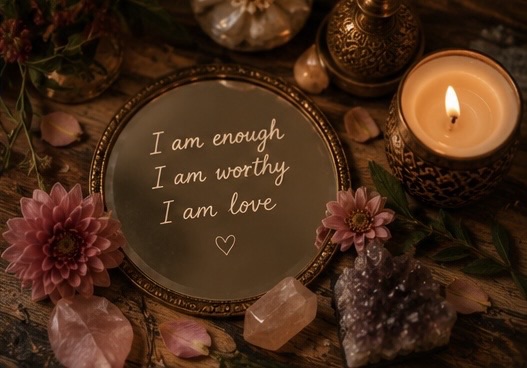
Sometimes love is obvious — kindness, affection, compassion, generosity, connection.
But sometimes what we see looks like the opposite of love. Someone is angry, cruel, constantly pushing others away. Underneath, I often see a person who is suffering and, on some level, longing for love.
That understanding doesn’t mean tolerating harmful behavior. Compassion and boundaries can coexist. I can understand that someone’s cruelty comes from their own wounds and still say: I will not allow you to hurt me.
Sometimes love means staying. Sometimes it means leaving. Sometimes the most loving thing we can do is let another person walk their own path without trying to save them.
Loving Your Body

The body is one of the first places we can practice love. Keeping yourself clean, nourishing yourself, moving, resting — all of it is love.
There’s a harder practice, too: loving the body you have today. There have been times I looked in the mirror and hated what I saw. Eventually I understood that wanting to change something isn’t the same as needing to reject what already exists. You don’t have to hate your body into becoming another body. You can say instead: I love you as you are today, and because I love you, I’m going to take care of you. Change can come from love instead of punishment.
The body also talks to us constantly. When you enter a place, or someone comes close, what happens inside you — do you feel peaceful or tense, expanded or contracted, energized or drained? The body often knows before the rational mind catches up. Self-love includes learning to listen to it.
Loving Your Mind
Self-love is the conversation you have with yourself when no one else can hear you. When you fail, do you attack yourself — stupid, incapable, not good enough — or do you ask, what is this teaching me?
I’ve come to see most of what we call mistakes as teachings. We learn by trying, by getting things wrong, by practice and correction. When we extract the wisdom, the mistake has served its purpose.
Self-love doesn’t stop us from seeing what needs to change — quite the opposite. Under the light of love, we can look even at our own darkness without turning it into a reason for rejection: we see our fears and insecurities clearly, and then we keep going. Sometimes we even laugh at ourselves along the way.
The Relationships We Choose
Relationships have been some of my greatest teachers of self-love. When I was younger, the way I was treated often reflected something I hadn’t yet understood about my own worth. I gave constantly — my energy, time, attention, care — until I finally asked myself: why am I giving another person things I’m not giving to myself?
As my relationship with myself changed, my relationships changed too. My boundaries got clearer. I learned when to leave — and that leaving doesn’t always mean there was no love. Sometimes people simply need their own space to grow. I also learned something freeing: when you love yourself, you’re not afraid to be alone.
Now I’d take more time before entering a relationship, and simply observe: How does this person treat themselves? How do they speak about themselves, and about others? How do they treat people when there’s nothing to gain? And eventually — how do they treat me? Time reveals a lot.

We Often Accept What We Believe We Deserve
We’re often drawn to people and situations that mirror something happening inside us. If I secretly believe I’m unworthy of love, I may stay around people who keep confirming that belief. If I constantly criticize myself, someone else’s criticism can feel strangely familiar. But when the belief shifts — I am worthy of love, respect, and peace — my choices start to shift too.
This is never about blaming someone for how they were mistreated. Another person’s choice to harm or betray belongs entirely to them. Self-love is what lets us recognize: this behavior doesn’t define my worth, and I don’t have to stay where I’m being harmed.
Boundaries Are Love
A boundary says: this is where I stand, this is what I accept, this is what I don’t.
Sometimes holding one means losing someone, and that can hurt. But self-love teaches us we don’t need to abandon ourselves to keep somebody else. We can love people and still let them go.
Protecting Your Energy
Self-love also means becoming conscious of energy — our thoughts, actions, food, habits, environments, and relationships all affect how we feel.
Raising your vibration simply means noticing what moves you toward clarity, patience, and peace. Lowering it means noticing what leaves you heavy, foggy, or depleted — constant gossip, criticism, negativity. You don’t need anyone else to tell you what’s good for you; start observing yourself. How do I feel before this, during this, and after? Let your body, emotions, and thoughts become part of your compass.

Self-Love and Intuition
As we learn to love ourselves, we begin to trust ourselves. We stop doubting every feeling and grow familiar with the language of intuition — which doesn’t always arrive as a sentence in the mind. Sometimes it’s the body relaxing, or a wave of tension, or an inexplicable sense of peace, or the simple feeling that something is wrong.
Loving ourselves means learning to listen — to the body, emotions, instincts, inner wisdom — while still giving ourselves time to understand what those signals mean.
Self-Love Is Not Ego
Self-love doesn’t say I’m better than you, and it doesn’t say I’m less than you. It says: I know who I am.
Imagine a fish comparing itself to an eagle. The fish could spend its life feeling inadequate because it can’t fly; the eagle could feel the same because it can’t swim. But the fish is here to discover how beautifully it can swim, and the eagle how high it can fly. Comparison is wasted energy — you can never become another person, only more fully yourself. I don’t need to diminish your beauty to recognize mine.
Self-Love and Abundance
How we value ourselves shapes our professional and financial lives too. When you love yourself, you start to understand the value of your time — one of our greatest resources. Giving it away endlessly, without balance, eventually leaves nothing for yourself.
I learned this through burnout — a point where I’d given so much of my energy and attention that there was nothing left for me. That taught me putting myself first isn’t selfishness; it lets what I give come from fullness instead of depletion. The same is true of abundance generally: knowing our worth means learning to receive as well as give — valuing our work, charging appropriately, accepting opportunities, believing we’re allowed a prosperous life. Giving and receiving need balance.
Judgment Becomes Compassion
Something shifts as we learn to accept ourselves: we stop needing to judge everyone else. Much of what we judge in others is something we’re consciously or unconsciously judging in ourselves. As we grow gentler with our own imperfections, we naturally grow more compassionate toward everyone else’s. Everybody has a journey. Life gets lighter when we stop spending our energy criticizing the people around us.
Love Without Expectations
Expectations can quietly turn into entitlement — because I gave you this, you owe me that. But love doesn’t have to be a transaction. We can give because we choose to, and receive what someone else genuinely offers, without making them responsible for our inner peace. That doesn’t mean abandoning our standards or boundaries — it means holding them without keeping score.

Where Do We Begin?
Self-love is a practice, not an overnight transformation. It begins with a decision: I choose to learn how to love myself.
Then get curious. Look at yourself physically, mentally, emotionally, energetically, spiritually. Ask where your beliefs came from — who told you that you weren’t beautiful, capable, or worthy enough? Was it ever really yours? Your childhood? Your parents? Society? A relationship?
Then build love through action: wake up, make your bed, nourish yourself, move your body, observe your thoughts, protect your peace, value your time, listen to your intuition, choose carefully who enters your life. When you uncover another wound or insecurity, let it be a place to grow — not another reason to reject yourself.
Imagine you’re a plant. Your roots are how you ground yourself. Positive thoughts are sunlight. Love is the water. A plant doesn’t need to be fully grown before it deserves water — it needs water because it’s growing. So do you.
Self-love isn’t the reward waiting at the end, once you’ve finally become who you wanted to be. It’s what helps you become that person.
And love, by nature, is infinite. There’s always another chance to open the heart a little more, understand yourself a little deeper, forgive a little more completely. No matter what happened before, you don’t have to keep withholding love from yourself because someone else once did.
Love begins with you.
And perhaps the bravest thing you can ever do is love yourself like you have never been hurt.
Love and gratitude
Naysha Silva
@



Leave a Reply